Why Is It Important to Know Your Reading Level?
What are Reading Levels and why should you care?
Biblionasium is dedicated non only to encouraging your child to read, but besides to making him or her a better reader.
If a book is also difficult, your child becomes frustrated and discouraged; a book that's besides easy is boring. Knowing your child's Reading Level is key to matching him or her to the nigh appropriate yet, challenging books. The best fashion to grow as a reader is past reading text that's non as well hard and non too easy, or what teachers call the "independent" reading level. That'south why we enquire about Reading Levels.
It is important to note that a broad range of reading ability exists within any form or historic period group. A Reading Level cess but tells teachers and parents where the kid is in terms of reading comprehension and potential, and provides an boosted, more specific measure out of the level of book difficulty that will benefit your kid.
Conversely, there are many books whose "content" may exist appropriate for a nine twelvemonth old, but whose text complication and vocabulary level might not. That is where "Text that fits" becomes of import.
What is "Text that Fits?"
Books can be like sneakers – the fit matters. A shoe salesman doesn't offer yous an "age nine or grade iv" basketball shoe; at that place's no such thing. Rather, he measures your child's pes to observe his individual size.
Unfortunately, some reading lists recommend "age nine, grade four" books. Just what if that child's reading ability is far higher than the "average" student his age? Or maybe he's non quite reading on a fourth-course level nonetheless. Similar the boy'southward age-9 basketball shoe, the text does not necessarily fit the student.
Linking the right volume to the right child helps ensure that all-important fit. Content, reader interest and book design all play a part. The Reading Level provides a supplemental measurement that considers the individual child. With this data, parents and teachers are able to help choose well-fitting books that give the reader just the correct amount of challenge.
How do I find out well-nigh my kid's Reading Level?
Reading Level assessments are usually adamant at your child's school. Amidst the more popular systems for reading assessment are The Lexile® Framework for Reading, Fountas & Pinnell, Reading Recovery, and DRA. Usually Reading Levels are reported on a pupil'due south report card. If you lot don't know your child's reading level, you can ask the teacher.
How can I discover a book's Reading Level on Biblionasium?
You can lookup a volume's Reading Level by simply searching for the title from our Search field. We have partnered with MetaMetrics®, developer of the widely adopted Lexile® Framework for Reading, to bring you the Lexile® text mensurate of tens of thousands of children'southward books on our site*.
The Lexile® mensurate is automatically displayed, afterwards the book championship and author information, and is represented equally a number followed by an "L" (for example, 1000L). It describes the volume's reading demand or difficulty. You can also see that information on your bookshelf. Simply select a book and go to the "Reading Level" tab.
What is the Lexile® Framework for Reading?
Unlike other measurement systems, the Lexile Framework determines reading power based on actual assessments, rather than generalized age or grade levels. Domestically and internationally recognized equally the standard for matching readers with texts, tens of millions of students worldwide receive Lexile measures that help them find targeted material from the more than than 400 million articles, books and websites that have been measured. Today, nearly one-half of the U.S. state education agencies have linked their statewide assessments to the Lexile scale. The utilize of Lexile measures also extends globally with tens of millions of individuals in more 165 countries.
What is the relationship between course equivalents and Lexile® measures?
There is no straight correspondence of a specific Lexile® measure to a specific grade level. Within any classroom or grade, there will be a range of readers and a range of reading materials. For instance, in a fourth-grade classroom there will exist some readers who are ahead of the typical reader (about 250L higher up) and some readers who are behind the typical reader (about 250L below). To say that some books are "simply correct" for fourth graders assumes that all fourth graders are reading at the aforementioned level. And we know that just doesn't fit.
Form equivalent scores should never be interpreted literally, but rather as rough estimates of grade level functioning.
Typical Reader Measures, past Grade
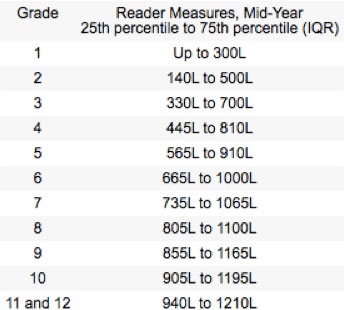
Notice that there is considerable overlap between the grades. This is typical of student reading levels and books published for each grade. It is important to note that the Lexile® mensurate of a book refers to its text difficulty only. A Lexile® measure does not address the content or quality of the volume. It is ever a good idea to preview materials prior to selecting them for a your kid.
What is the relationship between Lexile® measures and other Reading Systems?
There currently is no scientific research to confirm these correlations, however, the following chart shows approximate conversions betwixt some of the more than popular standards, including Fountas & Pinnell, DRA, and Reading Recovery leveling systems. This is not an official correlation but rather an approximation. While text complexity tools share some commonalities, there are also distinct differences.
What if I don't know my kid's Reading Level or Lexile® measure?
Don't worry; y'all don't need to know your child'due south reading level for y'all and your child to exist a part of Biblionasium. Instructor input, our wide option of books and peer interaction opportunities will keep your young reader moving forward. You likewise have the ability to see what level books your child is enjoying and reading, and whether he is moving ahead in his choices over time.
A general guideline is that books at the appropriate reading level for about students range from 100L below the Lexile® mensurate to 50L above it. If your child's estimate Lexile® measure is 1000L, then his or her Lexile® range would be 900L–1050L. Books inside this range will entertain readers while challenging them to build skills.
* Note: While the Lexile® Book Database has information for tens of thousands of fiction and nonfictions titles, occasionally at that place will exist a book or a version of a volume that does not have a Lexile® text measure.
For more than data most Lexile® please visit their website at world wide web.Lexile.com
Source: https://www.biblionasium.com/reading_levels
0 Response to "Why Is It Important to Know Your Reading Level?"
Postar um comentário