What Is the Last Shopwing at the Natural Art Musim
Perhaps the virtually common question that is posed to museum staff and educators dealing with things like fossils and other artefacts is: "Is it real?". In itself, it's a perfectly reasonable question, peculiarly when someone has the unexpected privilege to touch and hold a specimen and wants to know if this actually is an original of some kind.
Often though it can come up from incredulity, that something similar a tyrannosaur molar really could exist or be real. In my own case, working with dinosaurs, this is also a quite reasonable question – their bones tin can be and then outsized, bizarrely proportioned and downright strange that some scepticism that these could possibly be genuine is quite understandable. However, the intonation of the query if often evidently that someone quite only doesn't believe that these things are actually real but in some way a fabrication, and hither is where things get tricky as some specimens and exhibits are rather more than 'real' than others.
When it comes to fossils at least there are three main categories such specimens may fall into. First of all are real specimens. Actual fossils (bones, shells, leaves, tracks, eggs and then on) pulled from the basis and are absolutely real. Even these though are in some sense not quite genuine – a fossil os is very much a real thing, only it'southward no longer the original os that was in an ancient animal, simply one that has changed in mineral limerick over millions of years. Information technology may be perfectly preserved, only it's very much a fossil bone rather than an bodily bone.
In the example of things similar footprints or natural moulds from where bones or shells have been lost, there is some other degree of separation. Once again, they are pulled from the footing, but they are very much a remnant of where a fossil or organism was rather than being an actual function of that creature. And so even in the most real of specimens there is a bit of a disconnect between the original that was once live and the fossil in your hand, though few would contend that these are not real (although they may accept undergone a bit of repair and restoration to make them available to display).
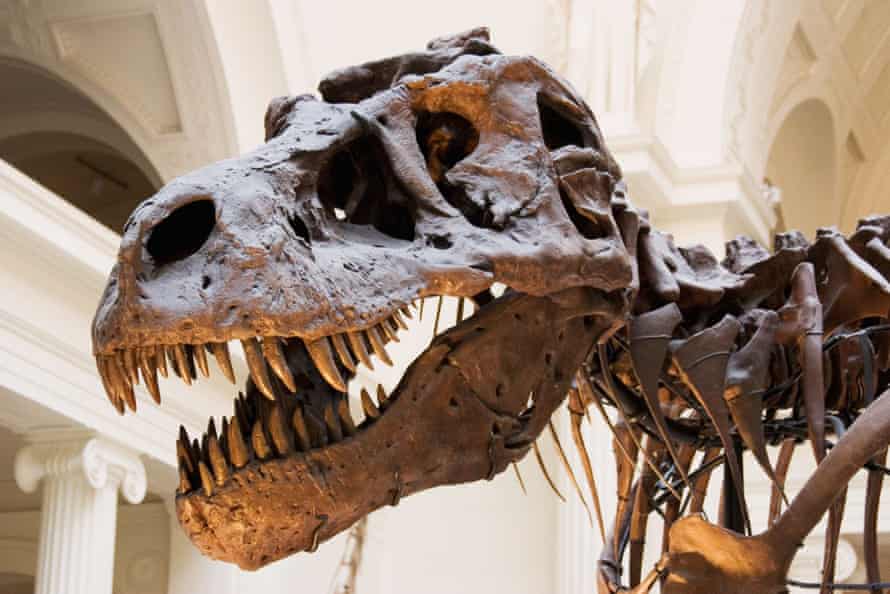
For large things like dinosaur skeletons at that place are relatively few on display anywhere. For a start at that place are simply and then many adept Tyrannosaurus or Stegosaurus skeletons to go around between all the museums that want them, and likewise it'south at present considered not such a smashing idea to drill holes through your priceless bones and then stand them up on brandish. Equally a result, many skeletons and other items in exhibitions are casts – copies of real bones. These are made in much the aforementioned way a dentist does of your teeth or you may have done at school by making moulds of resin or rubber cement and taking a cast from this. Whole skeletons can be produced in this way, but also even the best originals may accept pieces missing or too damaged to be shown and and so a cast (from another animal or another bone of the same one) might be used to fill in a missing arm or a rib.
Casts are at ane level clearly non existent – they are not a real specimen or fossil, merely as they are not faux or fraudulent. They are a replica that reproduces the original as accurately as possible (and often down to microscopic particular believe it or not, such is the allegiance of the moulds existence used). Sure a photograph of a Dali or Da Vinci is not a real painting or drawing simply it does not pretend to be, and clearly shows what the original was similar. Museums are generally good at flagging what is and is non real and some even include little keys to show which parts are made upwards of fossils and which from casts, or even ensure the two are very unlike colours.

Finally, we have models or sculptures of fossils. You tin can't ever make a cast of something if it is uncommonly fragile, or in that location may exist nothing to make a bandage of. The outset skeleton of a new species is the only one out there and so any missing parts can't easily be made up with a cast from another animal. There might be a close relative which probable had the same features and was about the correct size, but not necessarily. In this case, something will need to be created to make full in the gaps. It might be a bandage that is then modified in club to brand it expect right, or made be something fabricated from scratch.
Clearly, such creations are much less 'real' than a bandage or a genuine fossil, but again they are not exactly a fake either as they are based on what we know of these species and their anatomy. Yous don't have to accept the arms of a new tyrannosaur preserved to make a good sculpture when all of its close relatives take short arms with two fingers, and sure primal features of the joints and claws are near universal in carnivorous dinosaurs. Sculpting the arms and adding them to your mount will make the brandish a much amend representation of what the skeleton would have looked like than with leaving them out. Nosotros take a proficient agreement of, and can make solid predictions nearly, the missing parts and they are not a figment of imagination only based on existent enquiry and agreement of the creature'south biology and evolution.
Plenty of displays in museums, even of unmarried specimens, may mix fossils, casts and sculptures, and may even have multiple unlike individuals mixed together to make one skeleton in older ones. To varying degrees they are real, or at least representative or existent things, and then the simple question of "Is information technology real?" can be a surprisingly hard one to respond in simple terms. Even so, all of these represent what scientists know, or can work out, about the original organisms and that makes them all quite appropriate for displays.
Source: https://www.theguardian.com/science/2017/aug/30/what-exhibits-in-a-museum-are-genuine
0 Response to "What Is the Last Shopwing at the Natural Art Musim"
Postar um comentário