How Can Birth Marks Get Dark Again
By: Nick Nguyen, MD, FAAP & Sheilagh M. Maguiness, MD, FAAD, FAAP
Gazing at your new baby, taking in every little particular, is i of the many joys of parenthood. Among many unique features you might notice is a birthmark, a dissimilar-looking spot on the peel that a baby is born with or develops before long after nascency.
In that location are ii main types of birthmarks: pigmented, spots of skin that comprise actress pigment (color); and vascular, which contain extra claret vessels that didn't fully class. Both types are usually harmless, and some become away on their own. But some need to exist watched to make sure they don't cause problems. Be sure to talk with your pediatrician about whatsoever birthmarks or rashes you discover on your baby.
Vascular Birthmarks—Pinkish, Ruby-red & Blueish
Pink, ruby-red, and blue birthmarks oft are fabricated up of extra blood vessels. The extra blood tin make some vascular birthmarks feel warm to touch. Vascular birthmarks may expect and conduct differently depending on the type of blood vessels in them. The most mutual blood vessel birthmarks include:
Nevus Simplex: "salmon patch," "affections osculation" & "stork bite" birthmarks
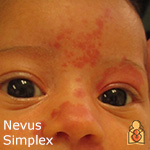 Nevus simplex are flat pink or cherry birthmarks that upwardly to lxxx% of babies are born with. They are collections of pocket-size, red blood vessels chosen capillaries. Often, these marks are located on the eyelids, forehead, dorsum of neck, superlative of caput, under the nose, and lower back. Sometimes, they are chosen "salmon patch" marks, "stork bites" (when located on back of the cervix) and "angel kisses" (when they're betwixt the eyebrows).
Nevus simplex birthmarks usually will go away on their own by the time your baby is a toddler. Do not be alarmed if the birthmark gets darker when your babe becomes more emotional or active—this is normal.
Most nevus simples are totally harmless and do not need handling. But be sure to talk with your pediatrician if they are large or located in unexpected areas.
Port Wine Stains
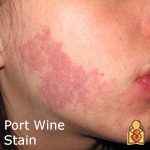
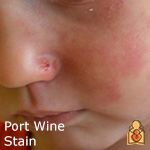 Port vino stains are fairly mutual, seen in most 3 in i,000 children. They are similar to nevus simplex: flat, pinkish or ruby birthmarks made up of actress capillaries. They besides are visible at birth. But these birthmarks are unremarkably larger than nevus simplex and may affect more areas of the confront and torso. Dissimilar another birthmarks, port wine stains practice not get away. They abound equally your child grows, but slowly. Over time, they may go darker and thicker.
Port wine stains aren't usually linked to whatever health problems. If the birthmark affects a certain part of the face, like the eyelid and brow, though, it may exist related to a condition called Sturge-Weber syndrome. This condition is rare, but your physician may recommend more evaluation or testing if your baby is at take chances.
Some children and teens are not bothered by their port-wine stain, while others may feel self-conscious nearly them. Laser treatment may exist able to lighten the birthmark some and help foreclose concealment and thickening. Just information technology will not "erase" the birthmark in about cases.
Infantile Hemangiomas
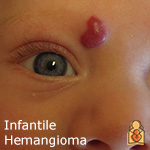
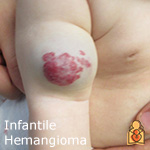 These benign growths, which commonly announced in the first few weeks of life, are made of extra blood vessels in the skin. Infantile hemangiomas are fairly common--found in upwardly to 5% of infants. They usually abound rapidly, and then gradually shrink and fade. If they class near the top of the pare, they are ruby-red (and sometimes called "strawberry marks"). Deeper in the pare, they may look blue or royal, like bruises.
Infantile hemangiomas grow most quickly in the outset 5-7 weeks of life, so it is important to talk to your pediatrician about them early. Some hemangiomas may exist associated with certain health issues and require boosted testing and/or treatment. Condom treatments are bachelor today for problem hemangiomas. Merely these treatments commonly piece of work best when started soon after these birthmarks form--generally past around one calendar month historic period. Talk with your pediatrician if you lot think your baby may have an infantile hemangioma.
Congenital Hemangiomas
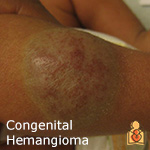 Congenital hemangiomas are present at birth. Sometimes, they can be seen during prenatal ultrasound exams. They are different from infantile hemangiomas and much rarer. This type of hemangioma does non abound after the infant is born. Built hemangioma often look like a large round or oval bump or mass. They tend to be purple to blue, simply may also accept tiny red blood vessels on the surface and a white ring effectually the base.
Some of these birthmarks begin to disappear chop-chop (a type called rapidly involuting congenital hemangioma). Another type, non-involuting congenital hemangioma, does not become away at all. In virtually cases, congenital hemangiomas are not dangerous and exercise not need treatment. If the birthmark does not go abroad, it can be removed with surgery or other treatments when a child is older.
Venous Malformation
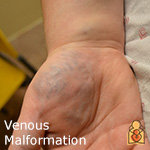
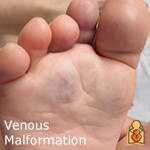 Venous malformations are tangles of veins in the skin that did not form properly during evolution. The veins give these birthmarks a blue or regal colour. They are present at nascence but may not become obvious until the teenage years. The veins can become larger with activity or certain positions, and they may become painful. Venous malformations are rare, affecting around two in 10,000 children.
These birthmarks may crusade no problems at all. But treatment may be needed if the birthmark is painful or affects your child'due south activities. Sometimes, pocket-size clots called phleboliths form in the veins. In well-nigh cases, these clots are not harmful but tin be difficult and cause pain. Compression garments, medications, surgery or procedures may exist among treatment options.
Most venous malformations are located only in the pare, but sometimes they tin can too be constitute in muscles, bones, or organs. Your doc may recommend a scan to go more than information about your kid'due south birthmark.
Blood Vessel Birthmarks | ||
|---|---|---|
| What does it expect like? | Does it need to be treated? | |
| Nevus Simplex |
|
|
| Port-Wine Stain |
|
|
| Infantile Hemangioma |
|
|
| Congenital Hemangioma |
|
|
| Venous Malformation |
|
|
Pigmented Baby Birthmarks—Brown & Grey
Dark-brown and grey birthmarks may be made of extra melanocytes—the cells that produce paint (color) in the skin. Pigmented birthmarks tin can look and bear differently from each other. Some are harmless, but others can come with wellness problems for your baby.
Built Melanocytic Nevi (Moles)
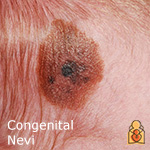
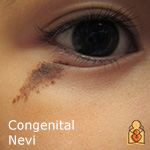 Congenital melanocytic nevi are normally called moles. They can be present at nascency or appear during the first year of life. These birthmarks are common, found in one-3% of newborns. Congenital nevi can wait very unlike from each other. Most are chocolate-brown, simply they may as well accept shades of pinkish, ruddy, or black. Sometimes they have bumps or hair, and they may become rough or raised. Most congenital melanocytic nevi are harmless and ordinarily do not require treatment or removal. Many dermatologists and pediatric dermatologist simply monitor them at well-kid visits. They can besides tell you what changes you lot should spotter for in your kid's birthmark.
A nevi normally grows larger as your child grows, but non chop-chop. They are classified based on their size: small, medium and large/giant nevi. Large and giant nevi may have a higher adventure for a type of skin cancer, melanoma, compared to pocket-sized congenital nevi or other moles that announced afterwards in life. Information technology's important for all children, but specially those with this blazon of birthmark, to wear lord's day protection outdoors.
A child with more than one congenital melanocytic nevus always needs to be evaluated past his or her pediatrician or pediatric dermatologist. Having more than one congenital nevus at nascency may exist related to problems with the brain and spinal string. Your doc may recommend a browse of these areas in this case, but this is extremely rare. Learn more and watch a video on identifying moles from The Society for Pediatric Dermatology.
Café-au-lait
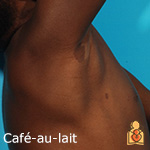 Café-au-lait means "java with milk," which describes the calorie-free chocolate-brown color of these common birthmarks. As many as 20-30% of people have one. The marks are apartment and usually circular or oval shaped. Most are smaller than a kid's palm and have smooth borders. They are visible at birth or develop very early in life.
Most café-au-lait spots are harmless. They are unlikely to turn into peel cancer, but may become darker with more lord's day exposure. A large café au lait spot with jagged borders may be linked with a rare genetic condition called McCune-Albright syndrome. Multiple café-au-lait spots tin can be a sign of other weather, including one called neurofibromatosis. If your child has a large café-au-lait spot, more than than 5 spots, or spots in the armpits/groin, talk with your pediatrician most them.
Dermal Melanocytosis
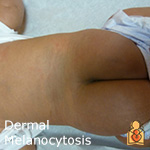 These are the most common birthmarks in babies with highly pigmented pare. They are seen in 85% of Asians, 96% of blacks & 46% of Hispanic babies at birth. They are ordinarily located on the lower dorsum and bottom, but some babies may have spots on different areas of the body. These birthmarks may be a mix of colors including brownish, grayness, blue and blackness. Their unique color comes from having paint in dissimilar layers of the peel.
Most dermal melanocytosis birthmarks, which used to be called Mongolian spots, gradually fade. Many disappear by the toddler years. The bulk of them are harmless and practice not need handling. In rare cases, these birthmarks may exist associated with genetic conditions. If your baby has other health problems and several spots, please talk with your pediatrician.
Pigmentary Mosaicism
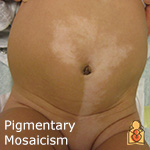 Mosaicism is a give-and-take that means ii sets of Dna, or genes, are present in the same person. In pigmentary mosaicism, different genes might touch the color of the pare. These changes can exist subtle or very large. Pigmentary mosaicism birthmarks have unique patterns including lines and swirls. With sunday exposure, areas can become lighter or darker.
Even though the genetic change involved with pigmentary mosaicism is present at birth, the affected skin may not turn color until later in life. Sometimes sun exposure can cause this to happen. These changes can requite the illusion that the birthmark is "spreading." In nearly children, pigmentary mosaicism is harmless. A small number of may take problems with the bones, eyes or brain specially if their birthmark covers a large area of their trunk, then your pediatrician may recommend some tests.
Pigmented Baby Birthmarks | ||
|---|---|---|
| What does it look like? | Does it need to exist treated? | |
| Built Melanocytic Nevi |
|
|
| Café-au-lait |
|
|
| Dermal Melanocytosis |
|
|
| Pigmentary Mosaicism |
|
|
Remember:
Nigh birthmarks are harmless and are function of what makes your child unique. But some types of birthmarks can come up with potential wellness issues or may crusade some children to feel cocky-conscious. That's why it is of import to talk with your pediatrician most whatsoever unusual marks or changes on your kid's skin. There are safe and effective handling options bachelor today that are especially constructive when started early.
Additional Information:
-
Infantile Hemangiomas: About Strawberry Baby Birthmarks
-
What is a Pediatric Dermatologist?
-
What is a Pediatric Plastic Surgeon?
-
12 Common Summer Pare Rashes in Children
Near Dr. Nguyen:
 Nicholas Nguyen, Doctor, FAAP, is a pediatric dermatologist and the Director of Pediatric Dermatology at Akron Children's Hospital in Akron, OH. Within the American University of Pediatrics (AAP), he is the early career physician liaison to the Section on Dermatology Executive Committee and is also the AAP Pediatric Dermatology Case of the Month editor.
About Dr. Maguiness:
 Sheilagh Chiliad. Maguiness, MD, FAAD, FAAP, is a pediatric dermatologist and the Managing director of Pediatric Dermatology at the University of Minnesota, Minneapolis, MN. Dr. Maguiness is VP of Teaching and Career Development for the Society for Pediatric Dermatology. Within the American Academy of Pediatrics, she is a member of the Section on Dermatology Executive Commission and is Chair of the Section on Dermatology Education Sub-Commission.
The information contained on this Spider web site should not exist used every bit a substitute for the medical care and advice of your pediatrician. There may be variations in treatment that your pediatrician may recommend based on private facts and circumstances.
Source: https://www.healthychildren.org/English/ages-stages/baby/bathing-skin-care/Pages/Your-Newborns-Skin-Birthmarks-and-Rashes.aspx
0 Response to "How Can Birth Marks Get Dark Again"
Postar um comentário